The question that Pontius Pilate asked Jesus of Nazareth is still asked today (John 18:38). What is truth? Is it mere facts, supported by empirical data and accumulated observation? Is it based in law or reason? Can feelings also be a kind of truth? Is one’s personal experience simply a personal truth or is it the whole truth about a matter?
Truth cannot simply be a fabrication--a man-made construction based on convenience, preference, or delusion.
Is truth reality? Or is reality just a perception?
Jesus said you can know the truth, and the truth will make you free (John 8:32).
But how? Throughout the Gospel of John, Jesus proclaims Himself as the one bringing the truth, being the truth, and speaking the truth. In fact, he told Pilate that he (Jesus) was born with the purpose of bringing truth to the world (John 18:37).
In His final words to His disciples, Jesus told them that He was the Truth (John 14:6), and that He would send the Spirit of Truth to guide them into all truth (John 16:13) when he left them bodily.
Believing such a claim requires some faith, but also some discretion. Not everyone crying “Lord, Lord” is truthful. The Scriptures themselves warn of false Christs.
Note this: Christ’s integrity was never in question as he underwent trial by his accusers. Before the high priests who initiated the arrest of Jesus, he reminded them that all of his teachings and actions were done publicly (John 18:20-22). No covert operations. No clandestine conspiracies. When he was struck in the face for his remark, he challenged them to reveal any evidence that what he had ever said had been wrong, had ever not been the truth (John 18:23). They could not. Not then. Not later. Not ever.
At first, followers failed. Peter denied Jesus that night. Judas betrayed him. All but John abandoned him at the cross. But never once was Jesus Christ found to be anything other than what He professed: the Way, the Truth, and the Life. His resurrection removed any doubt from the disciples' minds: they all died a martyr's death for their belief in His truth.
So when I discuss “truth” with my students, what I am really often discussing is man’s various perceptions of truth or his levels of understanding and coping with his realities. These are debatable. Temporal. Earth-bound and situational. Cultural and frequently circumstantial.
Borrowing from the wisdom of Solomon, “Fire tests the purity of silver and gold, but the Lord tests the heart” (Proverbs 17:3), I believe much truth is discoverable by man over the process of time and testing, but that the ultimate revelation of truth cannot be attained apart from God who knows all and sees all.
Therefore, the pursuit of truth cannot be fully realized without spiritual knowledge. It is the secularized mind that is not fully enlightened.
Can I, flawed and limited, know truth? According to Christ’s own words, yes. But as the Apostle Paul wrote, right now we know only in part, although one day we will know everything completely, just as God knows now (I Cor. 13:12).
Monday, May 07, 2007


Thursday, April 26, 2007
What’s in your dirt?
I used to fancy myself a gardener—back when I actually had a garden. Since moving to a house with more trees and shade than topsoil, my gardening has consisted of rearranging the monkey grass as to keep the yard from washing away. I’ve been rather successful with hostas (which isn’t saying very much). But lately, my cast-iron plants, which are reputed as indestructible, are looking, well, rather shabby.
My old yard had two vital natural elements: full sunshine and fertile soil. Many years ago, the yard had been a cow pasture up on Shades Mountain. Geoff and I spent our first year there putting all the St. Augustine grass clippings into the small garden plot at the back of our long grassy backyard.
Back then, I personally had two vital natural elements: time and energy. Geoff hand-tilled the plot; I took over the planting, hoeing, weeding, watering, and harvesting. For several summers, we enjoyed fresh green beans, cantaloupes, corn on the cob, lettuce, purple hull peas, and watermelon.
Earlier today, I was out in my back yard after a long rain-soaked morning planning to tool about in the flower bed that looked the most despairing. The damp soil should yield to the shovel better than usual, so I attempted to thin out and perhaps transplant my cast iron plants to a happier location.
During our six years here, Geoff and I have done much to amend the soil. We have leaf-mulched, pine straw mulched, and tried re-routing the sloping run-off. Our small patch of grass has actually doubled in the last year or two, but where we have managed to enrich the soil, the weeds have rapidly invaded.
A couple of months ago, I pulled hundreds of cherry laurel seedlings. About that many have returned since. These seedlings rapidly grow into bushes and, left uncut, will create a jungle of trees under the present canopy of oaks, sweet gums, and poplars.
The first analogy for my soul-soil is that its depth must be cultivated over time. Richness of spirit and soul does not come in one heavy dump truck load of spiritual activity, but over the steady and gradual composting of rich spiritual matter.
Another application comes from the observation that weeds flourish in good soil as much as flowers do. The healthier the soil, the more inviting for all seeds. A similar caution must be present in my soul. Enriching my soul will call for an expanding of my horizons and extensions of my boundaries past my comfort zones. In doing so, I must combine enrichment for the health of my soul with filtering mechanisms, such as accountability and consistent Bible study, for its protection and purification.
I do not believe God wants Christians to “play it safe” by circling the wagons and existing within a Christian “ghetto.” In the parable of the talents, the master chided the servant who played it safe by sitting on his talent and hiding it from the world. No risk meant no gain.
So, what’s in your dirt? Chances are, if the soil is rich enough to grow flowers, there will be some weeds that need hoeing as well. And that’s a good sign of a healthy soul-garden.
My old yard had two vital natural elements: full sunshine and fertile soil. Many years ago, the yard had been a cow pasture up on Shades Mountain. Geoff and I spent our first year there putting all the St. Augustine grass clippings into the small garden plot at the back of our long grassy backyard.
Back then, I personally had two vital natural elements: time and energy. Geoff hand-tilled the plot; I took over the planting, hoeing, weeding, watering, and harvesting. For several summers, we enjoyed fresh green beans, cantaloupes, corn on the cob, lettuce, purple hull peas, and watermelon.
Earlier today, I was out in my back yard after a long rain-soaked morning planning to tool about in the flower bed that looked the most despairing. The damp soil should yield to the shovel better than usual, so I attempted to thin out and perhaps transplant my cast iron plants to a happier location.
During our six years here, Geoff and I have done much to amend the soil. We have leaf-mulched, pine straw mulched, and tried re-routing the sloping run-off. Our small patch of grass has actually doubled in the last year or two, but where we have managed to enrich the soil, the weeds have rapidly invaded.
A couple of months ago, I pulled hundreds of cherry laurel seedlings. About that many have returned since. These seedlings rapidly grow into bushes and, left uncut, will create a jungle of trees under the present canopy of oaks, sweet gums, and poplars.
The first analogy for my soul-soil is that its depth must be cultivated over time. Richness of spirit and soul does not come in one heavy dump truck load of spiritual activity, but over the steady and gradual composting of rich spiritual matter.
Another application comes from the observation that weeds flourish in good soil as much as flowers do. The healthier the soil, the more inviting for all seeds. A similar caution must be present in my soul. Enriching my soul will call for an expanding of my horizons and extensions of my boundaries past my comfort zones. In doing so, I must combine enrichment for the health of my soul with filtering mechanisms, such as accountability and consistent Bible study, for its protection and purification.
I do not believe God wants Christians to “play it safe” by circling the wagons and existing within a Christian “ghetto.” In the parable of the talents, the master chided the servant who played it safe by sitting on his talent and hiding it from the world. No risk meant no gain.
So, what’s in your dirt? Chances are, if the soil is rich enough to grow flowers, there will be some weeds that need hoeing as well. And that’s a good sign of a healthy soul-garden.
Thursday, April 12, 2007
Greetings - la dolce vita remembered!

Greetings, friends! I have a request for your continued patience as I explore some new computer technologies: a website, a photoshop, and maybe a multimedia project.
I am also currently reading several books, which include John Ortberg's If You Want to Walk on Water, You've Got to Get out of the Boat, Frances Mayes' A Year in the World, and a Nicholas Sparks' book that I started at the beach a few weeks ago and haven't finished yet.
This is a photo of me relaxing in Italy last May, enjoying la dolce vita at a Tuscan villa. Memories of my visit there continue to enrich my heart and mind almost a year later.
Part of Mayes' book and Ortberg's is an encouragement to LIVE NOW and not get reduced to merely existing and surviving.
I want this to be true in every area of my life: my marriage, my family, my spiritual life, my scholarship/teaching, everything. It does mean choosing some things over others, so I am seeking to make the best choices--the ones that will be sweet today and even sweeter tomorrow.
I am also currently reading several books, which include John Ortberg's If You Want to Walk on Water, You've Got to Get out of the Boat, Frances Mayes' A Year in the World, and a Nicholas Sparks' book that I started at the beach a few weeks ago and haven't finished yet.
This is a photo of me relaxing in Italy last May, enjoying la dolce vita at a Tuscan villa. Memories of my visit there continue to enrich my heart and mind almost a year later.
Part of Mayes' book and Ortberg's is an encouragement to LIVE NOW and not get reduced to merely existing and surviving.
I want this to be true in every area of my life: my marriage, my family, my spiritual life, my scholarship/teaching, everything. It does mean choosing some things over others, so I am seeking to make the best choices--the ones that will be sweet today and even sweeter tomorrow.
Wednesday, March 28, 2007
Spring Herald of Trees
Quiet, still, towering oaks and poplars
stand guard above us, sheltering,
Or among us: small delicate Japanese maples,
friendly dogwoods, cheerful crepe myrtles.
Great trees of the South.
Fragrant pines and magnolias, evergreen and lively;
Blooming tulip trees, flowering redbuds –
Heralds of spring dressed in brightest array.
A tree fell once on my house.
Hurricane Ivan roared in from the Gulf
And ripped the 100 foot white oak
From its shallow bedrock footing.
Its massive stump still scars my yard,
Reminding me of its loss
While its limbs, fallen and broken,
Have warmed my hearth for two winters now.
As a child, I climbed trees,
Built forts beneath them.
They were friends, protectors,
Strong, sturdy, available players
In my make-believe adventures.
Trees wear their scars with grace,
Without shame.
They stand their ground until downed
By disease, or acts of God, or our ingratitude.
Trees stay though cars and people and animals
Move around them, coming and going.
Trees are connected to life, to the soil, to the air.
Their roots reach for water and for an anchor beneath.
Their branches reach for the sunlight
And spread their leaves heavenward.
Oak and maple, poplar and pine.
Dogwood, redbud, magnolia, and elm.
Great trees of the South.
I watch as you awaken to spring
And I welcome you,
Great friends.
stand guard above us, sheltering,
Or among us: small delicate Japanese maples,
friendly dogwoods, cheerful crepe myrtles.
Great trees of the South.
Fragrant pines and magnolias, evergreen and lively;
Blooming tulip trees, flowering redbuds –
Heralds of spring dressed in brightest array.
A tree fell once on my house.
Hurricane Ivan roared in from the Gulf
And ripped the 100 foot white oak
From its shallow bedrock footing.
Its massive stump still scars my yard,
Reminding me of its loss
While its limbs, fallen and broken,
Have warmed my hearth for two winters now.
As a child, I climbed trees,
Built forts beneath them.
They were friends, protectors,
Strong, sturdy, available players
In my make-believe adventures.
Trees wear their scars with grace,
Without shame.
They stand their ground until downed
By disease, or acts of God, or our ingratitude.
Trees stay though cars and people and animals
Move around them, coming and going.
Trees are connected to life, to the soil, to the air.
Their roots reach for water and for an anchor beneath.
Their branches reach for the sunlight
And spread their leaves heavenward.
Oak and maple, poplar and pine.
Dogwood, redbud, magnolia, and elm.
Great trees of the South.
I watch as you awaken to spring
And I welcome you,
Great friends.
Wednesday, March 21, 2007
Contemplating Simplicity: "dolce far niente"
Near the end of her book Bella Tuscany, Frances Mayes and her husband Ed wonder what they would most like to take back with them from Italy to a new house in San Francisco where they work (pages 268-270):
We ask each other what we could have done differently. And what can we take back to our lives in the new house? What accounts for the dramatic shift in our minds and bodies when we live here? And, in California, aren’t we frequently out of control?
… “Taking buckets of time back is the main thing.” [Ed observes]
“If only we could take back the siesta –free hours in the middle of the day.”
“Wouldn’t you like to call one friend and say, ‘How are you?’ and not hear the answer, ‘I’m so busy’?”
“Well, ‘I’m busy’ means several things—partly it means ‘I’m important.’ But maybe living life is so important that we shouldn’t be busy. At least not busy, busy, with that buzz-buzz sound.”
Ed tells his students to figure out how many weekends they have left, given the good fortune of normal life expectancy. Even to the young it’s a shock to see that there are only 2800 more. That’s it. Done for. Carpe diem, si’, si’, grab the days.
This reminds me of the counsel in Psalm 90:12: “So teach us to number our days that we may apply our hearts to wisdom.”
Hmmm…if I live another 40+ years (average life expectancy for a female in the U.S. is 87), that means I’ve got roughly 2100 left. Less than 500 of those will be with children at home.
Counting your days may also bring about an urgency that promotes busyness. A pressure to choose quantity of accomplishment over quality of living.
What is the measure of “quality living”? How can we know when we are merely enjoying life for our own self interests, at the expense of others’ needs? And when we are simplifying in order to improve the quality of our relationships?
That one line haunts me: “But maybe living life is so important that we shouldn’t be busy.” What are your thoughts on this?
One more thought/challenge: when was the last time that you experienced la dolce far niente – the sweetness of doing nothing?
We ask each other what we could have done differently. And what can we take back to our lives in the new house? What accounts for the dramatic shift in our minds and bodies when we live here? And, in California, aren’t we frequently out of control?
… “Taking buckets of time back is the main thing.” [Ed observes]
“If only we could take back the siesta –free hours in the middle of the day.”
“Wouldn’t you like to call one friend and say, ‘How are you?’ and not hear the answer, ‘I’m so busy’?”
“Well, ‘I’m busy’ means several things—partly it means ‘I’m important.’ But maybe living life is so important that we shouldn’t be busy. At least not busy, busy, with that buzz-buzz sound.”
Ed tells his students to figure out how many weekends they have left, given the good fortune of normal life expectancy. Even to the young it’s a shock to see that there are only 2800 more. That’s it. Done for. Carpe diem, si’, si’, grab the days.
This reminds me of the counsel in Psalm 90:12: “So teach us to number our days that we may apply our hearts to wisdom.”
Hmmm…if I live another 40+ years (average life expectancy for a female in the U.S. is 87), that means I’ve got roughly 2100 left. Less than 500 of those will be with children at home.
Counting your days may also bring about an urgency that promotes busyness. A pressure to choose quantity of accomplishment over quality of living.
What is the measure of “quality living”? How can we know when we are merely enjoying life for our own self interests, at the expense of others’ needs? And when we are simplifying in order to improve the quality of our relationships?
That one line haunts me: “But maybe living life is so important that we shouldn’t be busy.” What are your thoughts on this?
One more thought/challenge: when was the last time that you experienced la dolce far niente – the sweetness of doing nothing?
Tuesday, March 13, 2007
Grace to Be and Room to Become
The thought for today is from Eldredge’s book Captivating: "Real beauty offers others the grace to be and the room to grow."
To me, that best expresses the beauty and grace that Jesus brought to the many he encountered on earth, especially to the sinful: Zacchaeus, the woman at the well, the woman caught in adultery.
And how rare to experience that kind of beauty in a person. The grace to be (acceptance and love for who I am right now, no matter what) and the room to grow (the freedom to be who God designed me to be and not what others want me to be or think I should be, to meet their needs or their expectations). The saying “Please be patient with me. God isn’t finished with me yet” is a longing for that kind of beauty.
Real inner beauty offers others life and rest and hope. That is what Jesus brought to each sinner at the end of his or her destructive path: beauty for ashes, hope for despair, life instead of death.
I have also been pondering what my part in my journey is this past year. With my dog Jazzy (read Sept. 24'06 and Oct. 1'06 blog),I observed how she likes to take the lead, instead of following mine, whenever I try to take her on a walk with me. Her persistence to lead robs us of a pleasant experience together. And yet, I am so like Jazzy when it comes to walking with God. I desire to walk with Him. Follow Him. But I become impatient and lurch ahead---thinking that I have to contribute somehow to the journey process.
This week as I asked God the question (again), what is MY part in all of this? Out of the silence, He answered, “None of it...except to love me—be in love with me. And love others in that way too.”
My head still wrestles with this answer, but not my heart. My heart knows this is the true answer to the question I have been asking.
To me, that best expresses the beauty and grace that Jesus brought to the many he encountered on earth, especially to the sinful: Zacchaeus, the woman at the well, the woman caught in adultery.
And how rare to experience that kind of beauty in a person. The grace to be (acceptance and love for who I am right now, no matter what) and the room to grow (the freedom to be who God designed me to be and not what others want me to be or think I should be, to meet their needs or their expectations). The saying “Please be patient with me. God isn’t finished with me yet” is a longing for that kind of beauty.
Real inner beauty offers others life and rest and hope. That is what Jesus brought to each sinner at the end of his or her destructive path: beauty for ashes, hope for despair, life instead of death.
I have also been pondering what my part in my journey is this past year. With my dog Jazzy (read Sept. 24'06 and Oct. 1'06 blog),I observed how she likes to take the lead, instead of following mine, whenever I try to take her on a walk with me. Her persistence to lead robs us of a pleasant experience together. And yet, I am so like Jazzy when it comes to walking with God. I desire to walk with Him. Follow Him. But I become impatient and lurch ahead---thinking that I have to contribute somehow to the journey process.
This week as I asked God the question (again), what is MY part in all of this? Out of the silence, He answered, “None of it...except to love me—be in love with me. And love others in that way too.”
My head still wrestles with this answer, but not my heart. My heart knows this is the true answer to the question I have been asking.
Monday, March 05, 2007
A Blog Year in Review
This month marks the one year anniversary of my blog so I went back and read my entries from March 2006: the inaugural issue, the questions that launched the journey, the topics that began a digital conversation – even if just within myself and then recorded for others to read.
These are my reflections...
The social networks Facebook and MySpace (March 16 ’06 entry) continue to trouble and fascinate me. Although I have figured out a way to view my child’s pages, it continues to bother me that there is not an automatic parental monitoring feature. Teens can write or post anything, and it is up to them to police it.
My Bible reading (March 20 ’06) is not as systematic as it was a year ago when every hour of my day had to be scheduled to meet the dueling demands of motherhood, marriage, and full-time graduate thesis work. What I have tried to pursue instead is practicing the presence of God throughout my day-breathing Him in and out, as it were-instead of compartmentalizing my devotional time into a fixed time frame.
While I have often enjoyed a sustained sense of spiritual intimacy with God, my intercession for others became sporadic and I fell behind in my reading schedule. This is indeed part of my journey as I desire to live spiritually with and without routined spiritual disciplines to measure or gauge the quality of my spiritual devotion.
What I am contemplating now is a revised reading schedule to maintain consistency within a fluctuating schedule. And an intercession agenda, internally motivated and structured, that will assist my mind to execute what my heart desires: passionate prayer for the people I love.
There are missionaries that I do not want to forget to pray for. There are friends that I want to routinely bring supplication for. And I want to remember to pray diligently on the good days, instead of just fervently on the challenging days.
God has often prompted me to pray for loved ones and specific situations (often in the middle of the night), but I feel He is leading me to be more available to His prompting by planning quiet times to hear His voice.
Scheduling silence will not be easy.
These are my reflections...
The social networks Facebook and MySpace (March 16 ’06 entry) continue to trouble and fascinate me. Although I have figured out a way to view my child’s pages, it continues to bother me that there is not an automatic parental monitoring feature. Teens can write or post anything, and it is up to them to police it.
My Bible reading (March 20 ’06) is not as systematic as it was a year ago when every hour of my day had to be scheduled to meet the dueling demands of motherhood, marriage, and full-time graduate thesis work. What I have tried to pursue instead is practicing the presence of God throughout my day-breathing Him in and out, as it were-instead of compartmentalizing my devotional time into a fixed time frame.
While I have often enjoyed a sustained sense of spiritual intimacy with God, my intercession for others became sporadic and I fell behind in my reading schedule. This is indeed part of my journey as I desire to live spiritually with and without routined spiritual disciplines to measure or gauge the quality of my spiritual devotion.
What I am contemplating now is a revised reading schedule to maintain consistency within a fluctuating schedule. And an intercession agenda, internally motivated and structured, that will assist my mind to execute what my heart desires: passionate prayer for the people I love.
There are missionaries that I do not want to forget to pray for. There are friends that I want to routinely bring supplication for. And I want to remember to pray diligently on the good days, instead of just fervently on the challenging days.
God has often prompted me to pray for loved ones and specific situations (often in the middle of the night), but I feel He is leading me to be more available to His prompting by planning quiet times to hear His voice.
Scheduling silence will not be easy.
Tuesday, February 27, 2007
Finding my Way

This is a photo of one of the paths between the seaside villages of Cinque Terre. It is narrow, rocky, and its destination obscured. In fact, the path leads away from the Mediterranean (which would be to one’s left) and further into the mountain – away from where I was headed.
So often, this is what my life’s journey feels like—how about you?
The journey by footpath through Cinque Terre is unpredictable. The view is spectacular; but when the road is so precarious, I tend to see just what is immediately around me: the jutting rocks, my footing, the narrowness of the ledge, the obstacles. I lean forward, my heart beating rapidly in my ears, straining to catch the sounds of other travelers. I do not want to be completely alone in my journey.
The red paint that marks the path is rather a blight to the natural terrain, but there is some reassurance in knowing that I am on the right path. This is the way I am supposed to be going. I haven’t wandered off by mistake.
Other travelers do appear. Some with sweaty, but smiling faces. We exchange greetings with German tourists in the language of our shared journey: “Buon giorno!”
A beautiful city waits at the end of my path. In Cinque Terre, it is Vernazza, pictured below at night and at dawn.


Somewhere at the end of my spiritual journey, a beautiful city waits for me as well. It is a city of light, flowing with a river of pure life. It sparkles like a precious gem. The city will bring healing to the nations, and no evil will enter there (Revelation chapters 21 and 22).
The path to get there is narrow, and few there be that find it (Matthew 7: 13-14). Jesus said He was “the way” (John 14:16). His Word will be a “light to my path” and a lamp for my feet” (Psalm119:105).
With my heart, I see the city and trust the path I am on to get there. With my heart, I hope, and love, and believe.
And that… is living spiritually in the everyday.
Tuesday, February 20, 2007
Beautiful Feet
“How beautiful are the feet of those who bring good news”(Romans 10:15)!
Tears welled up in my eyes Sunday morning and the lump in my throat thickened as I watched eleven missionary families march into our church sanctuary bearing the flag of their mission country during slides of their field work.
I was overwhelmed with the beauty of their sacrifice, with the beauty of their humble countenance, and with the beauty of the spirit in them that for the “joy set before them,” they have endured so many things to bring the hope and freedom of the gospel to the least among people around the world.
This is the first Missions Conference (as a missionary participant) for my friend Marge who a year ago this time was diagnosed (twice), then healed of throat cancer. Now a year later, she and her family have been called to Costa Rica, accepted by a mission board, and are raising support for ministry to homeless and destitute Nicaraguan refugees – the least among the people of Costa Rica.
How beautiful her heart, with all its passion and all its pain, is to me. How beautiful her love for her family and her love for those unloved people.
At the Ladies Missionary Luncheon today, I met some of the dear women who labor in difficult locations across the globe to bring food, education, and the love of Jesus to tribes in third world countries or Eurasian countries impoverished by years of communist rule.
For an ice-breaker, I asked them to share the most unusual food item they had ever eaten (I was the emcee for the luncheon). Wasp larvae, eels, sheep heads, intestines of various animals, a fish stomach, fried termites and rats were among those found on the “menus.”
For many the challenge of finding and storing uncontaminated edible food is a daily one. For others, the challenge was keeping up with the laundry when water and power are not always available, even if they did own a small clothes washer (dryers are a luxury).
I learned that ironing your clothes is not only a matter of neatness, but also a matter of health—it reduces the number of invisible bugs that can make their home in your underwear!
I am reflecting on so many things as I write this: gratitude for what I have, awe for these beautiful ladies, and a new wonder about living spiritually in the everyday.
Tears welled up in my eyes Sunday morning and the lump in my throat thickened as I watched eleven missionary families march into our church sanctuary bearing the flag of their mission country during slides of their field work.
I was overwhelmed with the beauty of their sacrifice, with the beauty of their humble countenance, and with the beauty of the spirit in them that for the “joy set before them,” they have endured so many things to bring the hope and freedom of the gospel to the least among people around the world.
This is the first Missions Conference (as a missionary participant) for my friend Marge who a year ago this time was diagnosed (twice), then healed of throat cancer. Now a year later, she and her family have been called to Costa Rica, accepted by a mission board, and are raising support for ministry to homeless and destitute Nicaraguan refugees – the least among the people of Costa Rica.
How beautiful her heart, with all its passion and all its pain, is to me. How beautiful her love for her family and her love for those unloved people.
At the Ladies Missionary Luncheon today, I met some of the dear women who labor in difficult locations across the globe to bring food, education, and the love of Jesus to tribes in third world countries or Eurasian countries impoverished by years of communist rule.
For an ice-breaker, I asked them to share the most unusual food item they had ever eaten (I was the emcee for the luncheon). Wasp larvae, eels, sheep heads, intestines of various animals, a fish stomach, fried termites and rats were among those found on the “menus.”
For many the challenge of finding and storing uncontaminated edible food is a daily one. For others, the challenge was keeping up with the laundry when water and power are not always available, even if they did own a small clothes washer (dryers are a luxury).
I learned that ironing your clothes is not only a matter of neatness, but also a matter of health—it reduces the number of invisible bugs that can make their home in your underwear!
I am reflecting on so many things as I write this: gratitude for what I have, awe for these beautiful ladies, and a new wonder about living spiritually in the everyday.
Sunday, February 11, 2007
Beauty: Essential to Spirituality
Beauty as an essential ingredient to living spiritually? I had not considered beauty as a part of developing my spirit until lately as I re-read both Eldredge’s book Captivating and Frances Mayes’ book Bella Tuscany. Beauty, I might have considered, a physical and external distraction to my walk with God, a vain pursuit that revealed a self-centered preoccupation with the temporal and earthly. Certainly not eternal. Beauty is, after all, only skin deep, right?
Still, I could not fully explain the impact upon my inner person that the grand majesty of the Grand Teton mountains or the quiet cathedral-like beauty of the Muir redwoods has. A rural Tuscan countryside or the blue waters of Cozumel. The sun setting on the Gulf.
Now I am beginning to see natural beauty (pristine, pure, and glorious) as an expression of God’s beautiful person. And our attempts to create beauty in this world as an expression of our design: an image-bearer of our Creator.
In contrast, that which has no light or no life has no beauty. Decay, destruction, death; carnage, corruption, catastrophe— results of the fall and the curse, these hold no beauty for us, for they were not part of creation as God intended and purposed. And not part of His plan for eternity.
Have you read the final chapters of Revelations? The ones that describe the city of God, the crystal river, the jeweled foundations, the eternal light and joy? Everything there is beautiful because it is a true expression of God’s love and holiness.
Everything here that is truly beautiful, shining out from this sin-darkened world, is a reminder of who God is and what is in store in His eternal kingdom. Beauty ties the believer, not to the temporal and earthly, but to the spiritual for it stirs a longing for what is good and pure and lasting.
Beauty here is fleeting. In a moment, the sunset fades. The redwoods get ravaged by fire. The view of the Tetons gets obscured by storm clouds. The azure liquid in Cozumel grays when the sun removes its gaze.
The beauty that is in Christ and that is experienced in a relationship with Him is a treasure to be sought every day and to be fully realized in the eternal. Let the beauty that is around you draw you to the One who is truly beautiful and good. And let your life be a beautiful expression of who He is in and through you.
Still, I could not fully explain the impact upon my inner person that the grand majesty of the Grand Teton mountains or the quiet cathedral-like beauty of the Muir redwoods has. A rural Tuscan countryside or the blue waters of Cozumel. The sun setting on the Gulf.
Now I am beginning to see natural beauty (pristine, pure, and glorious) as an expression of God’s beautiful person. And our attempts to create beauty in this world as an expression of our design: an image-bearer of our Creator.
In contrast, that which has no light or no life has no beauty. Decay, destruction, death; carnage, corruption, catastrophe— results of the fall and the curse, these hold no beauty for us, for they were not part of creation as God intended and purposed. And not part of His plan for eternity.
Have you read the final chapters of Revelations? The ones that describe the city of God, the crystal river, the jeweled foundations, the eternal light and joy? Everything there is beautiful because it is a true expression of God’s love and holiness.
Everything here that is truly beautiful, shining out from this sin-darkened world, is a reminder of who God is and what is in store in His eternal kingdom. Beauty ties the believer, not to the temporal and earthly, but to the spiritual for it stirs a longing for what is good and pure and lasting.
Beauty here is fleeting. In a moment, the sunset fades. The redwoods get ravaged by fire. The view of the Tetons gets obscured by storm clouds. The azure liquid in Cozumel grays when the sun removes its gaze.
The beauty that is in Christ and that is experienced in a relationship with Him is a treasure to be sought every day and to be fully realized in the eternal. Let the beauty that is around you draw you to the One who is truly beautiful and good. And let your life be a beautiful expression of who He is in and through you.
Monday, February 05, 2007
Spiritual living in the everyday dramas – my quest
One of my ongoing pursuits this past year has been a deeper understanding of how to live spiritually as a Christian in a physical world. I do not want to compartmentalize my spirituality into a daily or weekly ritual. But my current question is (see the entry Taking the Lead-Jazzy's story-Oct.1'06) what is my part in this journey? How can I be more spiritual as I live in the physical?
How much of being spiritual is the part when I am still, reflective, devotional, and meditating on God’s Word in a private, personal worship time? And what does that look like when a car ahead of me in carpool straddles the two carpool lanes and clogs up the traffic flow!?! Or when my children all take turns getting a virus, just as my copay increases and my part-time income decreases!
While I can see my ability to handle these (minor) challenges with grace and patience grow as I devote myself to seeking a godly, eternal perspective on life, the disparity between the spiritual depths I reach when I am engaged in a heart-to-heart with my Maker and the pettiness at which I can get caught up in any given day is disturbing to me. It is this awareness of my inner spiritual poverty, however, that keeps me on this quest.
This week, a conversation about the movie trilogy Lord of the Rings prompted an insight about this very issue, at least at a symbolic level. In this story by Tolkien, the heroes are engaged in a battle of good versus evil that will determine the fate of Middle Earth. The battle is both spiritual and physical.
Spiritually, the heroes must overcome their own vulnerability to evil, their mistrust of team members (the fellowship), the pain of betrayal, fear of failure, and the temptation to despair in the light of overwhelming obstacles. Physically, they must endure many forms of suffering, and they will all very literally engage in more than one hand-to-hand combat, to-the-death fight. Blood will be spilt, and no one will be spared bodily harm. Not even the main hero, Frodo.
Evil, in the form of Orcs, goblins, and Uruk-hai, is ruthlessly brutal and singularly focused on the annihilation of all forms of life: trees, humans, hobbits, elves. The Uruk-hai, especially, are everything I might imagine a demonic force to look like in a physical form. Truly the stuff of nightmares! I think if we could see our spiritual enemy for who he really is- how utterly bent on our destruction and how abominably wicked he and his demonic horde are—it would look a lot like how evil is portrayed in this trilogy.
Although the battles are fought with real human (and elf and dwarf) effort, even to the death, the victories that are won are supernatural—connected to the faith and hope and love of the heroes in the face of staggering odds.
Through this analogy, I perceive another ray of light in my journey to learn the balance between my human effort and God’s amazing power and sovereignty to work in me:
On this earth, my life here plays out in the physical realm of circumstances, but the battles are lost or won in my heart where I choose either faith or fear, love or anger, rest or stress, hope or despair. These choices are my part in the journey. The outcomes of the external conflicts are His.
…and the quest continues…
How much of being spiritual is the part when I am still, reflective, devotional, and meditating on God’s Word in a private, personal worship time? And what does that look like when a car ahead of me in carpool straddles the two carpool lanes and clogs up the traffic flow!?! Or when my children all take turns getting a virus, just as my copay increases and my part-time income decreases!
While I can see my ability to handle these (minor) challenges with grace and patience grow as I devote myself to seeking a godly, eternal perspective on life, the disparity between the spiritual depths I reach when I am engaged in a heart-to-heart with my Maker and the pettiness at which I can get caught up in any given day is disturbing to me. It is this awareness of my inner spiritual poverty, however, that keeps me on this quest.
This week, a conversation about the movie trilogy Lord of the Rings prompted an insight about this very issue, at least at a symbolic level. In this story by Tolkien, the heroes are engaged in a battle of good versus evil that will determine the fate of Middle Earth. The battle is both spiritual and physical.
Spiritually, the heroes must overcome their own vulnerability to evil, their mistrust of team members (the fellowship), the pain of betrayal, fear of failure, and the temptation to despair in the light of overwhelming obstacles. Physically, they must endure many forms of suffering, and they will all very literally engage in more than one hand-to-hand combat, to-the-death fight. Blood will be spilt, and no one will be spared bodily harm. Not even the main hero, Frodo.
Evil, in the form of Orcs, goblins, and Uruk-hai, is ruthlessly brutal and singularly focused on the annihilation of all forms of life: trees, humans, hobbits, elves. The Uruk-hai, especially, are everything I might imagine a demonic force to look like in a physical form. Truly the stuff of nightmares! I think if we could see our spiritual enemy for who he really is- how utterly bent on our destruction and how abominably wicked he and his demonic horde are—it would look a lot like how evil is portrayed in this trilogy.
Although the battles are fought with real human (and elf and dwarf) effort, even to the death, the victories that are won are supernatural—connected to the faith and hope and love of the heroes in the face of staggering odds.
Through this analogy, I perceive another ray of light in my journey to learn the balance between my human effort and God’s amazing power and sovereignty to work in me:
On this earth, my life here plays out in the physical realm of circumstances, but the battles are lost or won in my heart where I choose either faith or fear, love or anger, rest or stress, hope or despair. These choices are my part in the journey. The outcomes of the external conflicts are His.
…and the quest continues…
Sunday, January 28, 2007
Time in an artesian bottle: la dolce vita
“If I could put time in a bottle….” Do you remember that song? From somewhere in my childhood growing up in the 1970’s, this song lingers in my brain with its haunting lyric of idyllic longing.
The precious commodity of time has been a recurring theme in my reading and in my life this week. Both of the books I am reading by Frances Mayes (her latest, A Year in the World and an earlier work, Bella Tuscany) reference time in quality and quantity as critical components to her travels and life choices. In 2001, Frances and her husband Ed left tenured professorships to travel abroad, visiting all the sites they had ever always wanted to visit “someday.” After the death of a parent, a few friends, and several struggles with cancer among her friends, they decided someday was now or never.
Bella Tuscany takes place a couple of years earlier when for the first time, she and Ed can spend more than just a summer or Christmas holiday at their home in Cortona, Italy. They take a six month sabbatical and arrive in early March to spend their first spring in Tuscany. A line from her preface says it all: “I came to Italy expecting adventure. What I never anticipated is the absolute joy of everyday life—la dolce vita” (xii).
Italians live life differently than Americans. Many would say they live it better. It has a lot to do with how they approach time. Time for a sumptuous meal. Time for friends and for family. Time for a hand-made pair of shoes or a tailored Armani suit.
Time is an essential ingredient for all that is worthwhile. Its quantity inextricably tied to quality.
I do not collect time in a bottle. Everyday the hourglass of time sifts me one moment at a time, at a rate of 24 hours a day—no more and no less. What I do with that time is collected in the mind’s book of memories or it fades to nothingness and meaninglessness.
The time ahead of me still seems like a vast reservoir of opportunity. My grandmother lived to be 90; I am 42. I’m not even halfway there yet. But the number of my days is not guaranteed. I am keenly aware that I have only a few years with my children at home.
What I want is la dolce vita—to find the sweetness in the everyday, whatever the season of my life.
The precious commodity of time has been a recurring theme in my reading and in my life this week. Both of the books I am reading by Frances Mayes (her latest, A Year in the World and an earlier work, Bella Tuscany) reference time in quality and quantity as critical components to her travels and life choices. In 2001, Frances and her husband Ed left tenured professorships to travel abroad, visiting all the sites they had ever always wanted to visit “someday.” After the death of a parent, a few friends, and several struggles with cancer among her friends, they decided someday was now or never.
Bella Tuscany takes place a couple of years earlier when for the first time, she and Ed can spend more than just a summer or Christmas holiday at their home in Cortona, Italy. They take a six month sabbatical and arrive in early March to spend their first spring in Tuscany. A line from her preface says it all: “I came to Italy expecting adventure. What I never anticipated is the absolute joy of everyday life—la dolce vita” (xii).
Italians live life differently than Americans. Many would say they live it better. It has a lot to do with how they approach time. Time for a sumptuous meal. Time for friends and for family. Time for a hand-made pair of shoes or a tailored Armani suit.
Time is an essential ingredient for all that is worthwhile. Its quantity inextricably tied to quality.
I do not collect time in a bottle. Everyday the hourglass of time sifts me one moment at a time, at a rate of 24 hours a day—no more and no less. What I do with that time is collected in the mind’s book of memories or it fades to nothingness and meaninglessness.
The time ahead of me still seems like a vast reservoir of opportunity. My grandmother lived to be 90; I am 42. I’m not even halfway there yet. But the number of my days is not guaranteed. I am keenly aware that I have only a few years with my children at home.
What I want is la dolce vita—to find the sweetness in the everyday, whatever the season of my life.
Sunday, January 21, 2007
Book Review: Fresh Faith by Jim Cymbala
I am participating in a monthly book study through our church's women's ministry, led by our pastor's wife, Karon Walls. Karon has come up with an excellent list of Christian books for us to read this year, and I thought it would be good to share some of these with you by way of review.
The book Fresh Faith: What Happens when Real Faith Ignites God’s People by the famous Brooklyn Tabernacle pastor Jim Cymbala is one in a series that includes Fresh Wind, Fresh Fire and Fresh Power. Published in 1999 with coauthor Dean Merrill, the book offers a straightforward, roll up your sleeves and take God at His Word approach to living the Christian life.
The power of this book comes not only from its reliance on Scriptural mandates and role models, but on the raw and rugged faithwalk of a pastor and his congregation as they have embraced truth and experienced a transformation among its members that has become legendary among American evangelical churches. However, Cymbala is quick to confess that neither he nor his flock has any special formula that unlocks the mystery of spiritual “success.” And it is that fresh, no-frills transparency that makes this book so appealing.
The book is structured in three sections. The first part, “Something is Missing,” addresses the absence of real vibrant faith in our churches and in our personal lives. Rather than placing blame, Cymbala takes aim at the Enemy who has stolen two of the most important weapons we have: faith and prayer. He asks, “Whatever happened to the core truth of the Protestant Reformation, namely, that we do not earn our way with God but rather receive his grace by faith?”(44). Instead of attacking the symptoms of unbelief, we must abandon our efforts to just try harder and instead place our complete faith in “God’s unfailing promises” (49).
The second section, “Getting Past the Barricades,” speaks to the circumstances and challenges in our lives that have dimmed or challenged our faith. The first is our own hurtful past: the mistakes we have made that make us feel unable and inadequate to receive God’s promises or the hurts and abuses others have inflicted upon us that cause us to doubt God’s goodness. Using Joseph as an example, Cymbala offers the hope of forgetting (“Manasseh”) and finding fruitfulness (“Ephraim”) in the land of our suffering.
Another challenge is the often gray area of how one is actually led by God on a daily basis. Can we trust God to lead us? Or are we mostly on our own? Cymbala calls for “sanctified reasoning” (70) that asks for God’s leading and then follows it as it is revealed. What often gets in the way of this, he says, is our own cleverness and our impatience to wait on God’s timing for a desired result. King Saul failed this test by offering the sacrifice himself. His lack of faith resulted in an act of disobedience that cost him his crown and his legacy. Sometimes, the test comes in the waiting as we become discouraged. Cymbala emphasizes endurance as a key component to a life-changing faith. Ultimately, however, great faith is rooted in an awareness of great grace. Life change is always an act of God’s grace and not our own effort. No matter how destructive the sin-choice or horrific the consequence, life-changing faith realizes that grace trumps it all. No exception. Faith in God’s grace to redeem is a fundamental requirement for a faith that pleases God and changes lives.
Part three, “Following the Divine Channel,” provides some concrete faith principles and paradigms that can be applied by every believer. First, he describes Abraham as a person of faith who followed (and sometimes failed to follow) God, but who endured as a legacy of faith because his faith was focused on the promises of God, rather than His commands. Cymbala’s most compelling insight comes from this emphasis on God’s promises as the basis of our faith. We tend to focus on God’s commands and have faith depending upon our level of obedience to those commands. Cymbala states, “It is true that God’s moral commands teach us where we fall short. That is necessary—but it does not bring a solution to our human dilemma. Only the promises bring us hope, if we respond in faith, as Abraham did” (152). Another key principle for gaining fresh faith is the inevitable refining process. Cymbala calls this “addition by subtraction” and encourages us to embrace, rather than fight, God’s work of purification.
Cymbala ends with a chapter with guidance on cultivating an “atmosphere of faith.” In addition to the practice of Bible study and prayer, we should look back with thanksgiving and forward with anticipation, focused always on the promises of God.
Laced with real-life stories of transformed New Yorkers and flesh-and-blood examples from Scripture, this book takes living by faith out of the theoretical and ethereal and places it right into the everyday, whether we find ourselves desperately at the end of our rope or whether we are just trying to find God in the day-to day challenges in our world.
The paperback published by Zondervan has 210 pages of text, an Epilogue of faith-building Scripture promises, and a study guide.
The book Fresh Faith: What Happens when Real Faith Ignites God’s People by the famous Brooklyn Tabernacle pastor Jim Cymbala is one in a series that includes Fresh Wind, Fresh Fire and Fresh Power. Published in 1999 with coauthor Dean Merrill, the book offers a straightforward, roll up your sleeves and take God at His Word approach to living the Christian life.
The power of this book comes not only from its reliance on Scriptural mandates and role models, but on the raw and rugged faithwalk of a pastor and his congregation as they have embraced truth and experienced a transformation among its members that has become legendary among American evangelical churches. However, Cymbala is quick to confess that neither he nor his flock has any special formula that unlocks the mystery of spiritual “success.” And it is that fresh, no-frills transparency that makes this book so appealing.
The book is structured in three sections. The first part, “Something is Missing,” addresses the absence of real vibrant faith in our churches and in our personal lives. Rather than placing blame, Cymbala takes aim at the Enemy who has stolen two of the most important weapons we have: faith and prayer. He asks, “Whatever happened to the core truth of the Protestant Reformation, namely, that we do not earn our way with God but rather receive his grace by faith?”(44). Instead of attacking the symptoms of unbelief, we must abandon our efforts to just try harder and instead place our complete faith in “God’s unfailing promises” (49).
The second section, “Getting Past the Barricades,” speaks to the circumstances and challenges in our lives that have dimmed or challenged our faith. The first is our own hurtful past: the mistakes we have made that make us feel unable and inadequate to receive God’s promises or the hurts and abuses others have inflicted upon us that cause us to doubt God’s goodness. Using Joseph as an example, Cymbala offers the hope of forgetting (“Manasseh”) and finding fruitfulness (“Ephraim”) in the land of our suffering.
Another challenge is the often gray area of how one is actually led by God on a daily basis. Can we trust God to lead us? Or are we mostly on our own? Cymbala calls for “sanctified reasoning” (70) that asks for God’s leading and then follows it as it is revealed. What often gets in the way of this, he says, is our own cleverness and our impatience to wait on God’s timing for a desired result. King Saul failed this test by offering the sacrifice himself. His lack of faith resulted in an act of disobedience that cost him his crown and his legacy. Sometimes, the test comes in the waiting as we become discouraged. Cymbala emphasizes endurance as a key component to a life-changing faith. Ultimately, however, great faith is rooted in an awareness of great grace. Life change is always an act of God’s grace and not our own effort. No matter how destructive the sin-choice or horrific the consequence, life-changing faith realizes that grace trumps it all. No exception. Faith in God’s grace to redeem is a fundamental requirement for a faith that pleases God and changes lives.
Part three, “Following the Divine Channel,” provides some concrete faith principles and paradigms that can be applied by every believer. First, he describes Abraham as a person of faith who followed (and sometimes failed to follow) God, but who endured as a legacy of faith because his faith was focused on the promises of God, rather than His commands. Cymbala’s most compelling insight comes from this emphasis on God’s promises as the basis of our faith. We tend to focus on God’s commands and have faith depending upon our level of obedience to those commands. Cymbala states, “It is true that God’s moral commands teach us where we fall short. That is necessary—but it does not bring a solution to our human dilemma. Only the promises bring us hope, if we respond in faith, as Abraham did” (152). Another key principle for gaining fresh faith is the inevitable refining process. Cymbala calls this “addition by subtraction” and encourages us to embrace, rather than fight, God’s work of purification.
Cymbala ends with a chapter with guidance on cultivating an “atmosphere of faith.” In addition to the practice of Bible study and prayer, we should look back with thanksgiving and forward with anticipation, focused always on the promises of God.
Laced with real-life stories of transformed New Yorkers and flesh-and-blood examples from Scripture, this book takes living by faith out of the theoretical and ethereal and places it right into the everyday, whether we find ourselves desperately at the end of our rope or whether we are just trying to find God in the day-to day challenges in our world.
The paperback published by Zondervan has 210 pages of text, an Epilogue of faith-building Scripture promises, and a study guide.
Sunday, January 14, 2007
Wedding Belles
I don’t think I have mentioned this before, but I direct weddings. For the months and weeks beforehand, I work with the bride and her mother to coordinate the plans that they have made for the bride’s special day. Then, the weekend of her wedding, I am there to pull it all together, just as planned.
In addition to directing weddings at my church (Shades Mtn. Independent Church in Hoover, Alabama), I direct weddings in the Colonial Chapel at the historic American Village in Montevallo, Alabama; and I have directed outdoor weddings in various locales: the beach, on estates, in gardens, and poolside.
As part of my spiritual journey, I consider it a great honor to assist couples with their wedding: it is one of the most spiritual commitments they make. Marriage is, in fact, the only human being-to-human being “covenant” relationship that two people will ever form. Upon the foundation of that covenant, a home is made and a family begun.
Elaborate, and often expensive, preparations are made: a question is asked, a promise is made, a ring is given and received, and wedding plans commence. Brides start their search for the perfect dress and the perfect wedding location. Will they walk barefoot in white onto a pristine beach as the sun sets? Or will she have the traditional wedding she has always dreamed of in the church she grew up in? Will the couple ride away to their honeymoon in carriage, limo, or vintage automobile? What color will the bridemaids’ dresses be? What style tuxedo for the groom? For the groomsmen?
So many decisions to be made. So many hopes resting on this one day. So much stress and anxiety for a thirty minute ceremony that will change their lives forever!
I have directed weddings long enough to sadly see some of them come undone. I have also enjoyed watching couples grow into a family as little ones have come along. To watch the mystery of two becoming one and out of that bond flow great ministry, great partnership, great love and family.
Bells in the steeple no longer ring out for each and every wedding, but they should. The belles and beaus that walk that aisle and say their “I do’s” have begun a dance together that is like no other.
Release the doves. Blow the shafar. Throw the flower petals. Strike up the band. Ring all the bells. Hold nothing back. Celebrate the beauty and mystery of it all.
In addition to directing weddings at my church (Shades Mtn. Independent Church in Hoover, Alabama), I direct weddings in the Colonial Chapel at the historic American Village in Montevallo, Alabama; and I have directed outdoor weddings in various locales: the beach, on estates, in gardens, and poolside.
As part of my spiritual journey, I consider it a great honor to assist couples with their wedding: it is one of the most spiritual commitments they make. Marriage is, in fact, the only human being-to-human being “covenant” relationship that two people will ever form. Upon the foundation of that covenant, a home is made and a family begun.
Elaborate, and often expensive, preparations are made: a question is asked, a promise is made, a ring is given and received, and wedding plans commence. Brides start their search for the perfect dress and the perfect wedding location. Will they walk barefoot in white onto a pristine beach as the sun sets? Or will she have the traditional wedding she has always dreamed of in the church she grew up in? Will the couple ride away to their honeymoon in carriage, limo, or vintage automobile? What color will the bridemaids’ dresses be? What style tuxedo for the groom? For the groomsmen?
So many decisions to be made. So many hopes resting on this one day. So much stress and anxiety for a thirty minute ceremony that will change their lives forever!
I have directed weddings long enough to sadly see some of them come undone. I have also enjoyed watching couples grow into a family as little ones have come along. To watch the mystery of two becoming one and out of that bond flow great ministry, great partnership, great love and family.
Bells in the steeple no longer ring out for each and every wedding, but they should. The belles and beaus that walk that aisle and say their “I do’s” have begun a dance together that is like no other.
Release the doves. Blow the shafar. Throw the flower petals. Strike up the band. Ring all the bells. Hold nothing back. Celebrate the beauty and mystery of it all.
Sunday, January 07, 2007
A Passionate Resolve

In spite of the bleak and often dismal backdrop of winter, the start of a new year always brings with it the promise and freshness of a new beginning-a hope for something better than what we have been or experienced before.
Resolutions are made. Or resisted. Sometimes making a resolution can doom an intention to failure, right from the start! How many have been made only to be broken before winter’s end?
A resolution can seem like self-imposed torture as a way of motivating myself to be what I ought to be, but have not been. The die- in diet. The ex- in exercise.
But there is something to be said for resolve. A choice of the will to make a change, for the better.
And to mean it.
Personally, I would love to be governed solely by purity of heart and mind: divinely focused passions that motivate richly intense and fulfilling experiences of love at every level of my relationships. A life overflowing with the goodness and grace of God, guided by wisdom and godly choices.
I fail so often at this, I wonder ever to strive at all for something so out of reach of my humanity. And yet…the hunger and longing for living spiritually in the everyday dramas continues. And tastes of such an indescribable life stir my appetite for more.
Oddly, the bleakness of winter is the best time of all for change. Leaves and foliage all stripped away, my naked backyard is exposed for critical scrutiny. With the removal of Christmas décor, the interior of my house seems stark and bare. Similarly, after all the frenzy of the holidays, my quieted life (however briefly this lasts) lays open and undressed awaiting the garment of a new life, new pursuits. Or resuming the old ones.
And so, I resolve to put on a new garment:
I resolve… to feed the hunger and fuel the passion that moves me in this spiritual pursuit.
I resolve… to nurture my spirit, as I have my mind.
…To tend the garden of my heart with great care and intention.
…To be open to more possibilities.
…To not miss the moment in today while I plan for tomorrow.
…To look in the eyes of another and see the uniqueness of that one immortal soul.
Wednesday, December 06, 2006
Happy Holy-days from my family to yours!
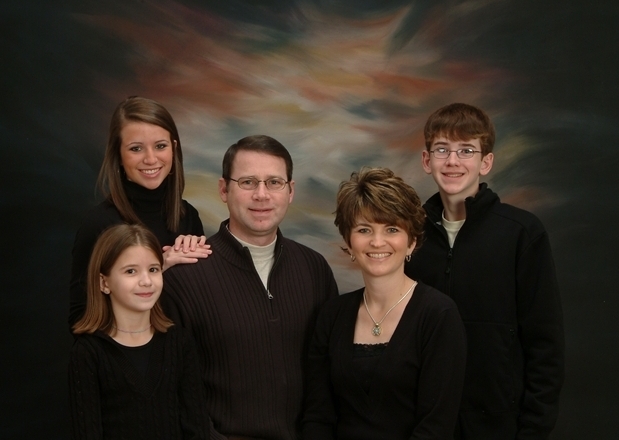
This Christmas season, I will be spending time with my family celebrating our love for each other through the exchange of gifts and the sharing of favorite holiday foods, memories, and traditions, like decorating the tree.
Most of all, however, we celebrate because of God's love for us, expressed in the gift of His Son Jesus to be our Saviour. Without Him, we could not know God personally, know of His love for us, and we could not be redeemed from our flawed human nature to be made part of His holy family.
During these holy days we call "holidays," I hope you will take time to consider His great gift to you: the free gift of unconditional love and acceptance, a place in the family of God, and an eternal home in heaven. It's so incredibly good-it's worth celebrating all year long!
Merry Christmas! Happy Holy-Days!
the Duncans
My blog will resume in January 2007.
Sunday, November 05, 2006
Women of Influence: Pt. 3 Our Sphere of Influence
So far, we have looked at how a woman's spirit has an influence on everyone she comes in contact with, whether she realizes it or not. God also has a divine sphere of influence for each and every woman, that may change over time.
Your sphere of influence is wherever God places you, for as long as He places you there.
Sometimes our spheres are expanded; sometimes they are focused and individual.
The apostle Paul is a great example. Shortly after his conversion on the Damascus road, he went to Jerusalem where his influence for the Gospel was met with skepticism. He had, after all, gone to Damascus to persecute the Christians, not join them!
The truth of his transformation was verified by others, particularly Ananias and Barnabas; but Paul’s influence was a threat to the Jewish leaders, so he was sent to Caesarea and his hometown of Tarsus (Acts 9).
Over and over throughout Paul’s life, his sphere of influence changed. For one, he traveled as a missionary throughout Asia Minor sharing the gospel everywhere he went. Then he was imprisoned.
You might be tempted to think that his influence was effectively neutralized by imprisonment. But no, God had actually expanded Paul’s influence. By limiting the face-to-face contact Paul had with others, the ministry of his letters lingers on as God-breathed Scripture today.
Along the way and often in prison, Paul wrote Romans, I and II Corinthians, Galatians, Ephesians, Philippians, Colossians, I and II Timothy, Titus, and Philemon. Perhaps even Hebrews, we don’t know for sure.
Everywhere Paul went, he was an influence for Christ: when he sang in the Philippian jail with Silas, when he appeared to Governor Felix and then Festus, when he was shipwrecked near Malta, and when he was placed under Roman guard.
Paul claimed no position except bondservant of Jesus Christ. All of his former titles and positions of influence, he discarded as worthless (Philippians 3:4-9).
Think of Daniel and of Joseph. The high positions of influence came after an evident God-filled spirit. Daniel’s sphere of influence changed from that of a young captive from a conquered land to a high-ranking official in a world empire. Even with that “promotion,” his influence was most profound when he spoke from inside a lion’s den. (Daniel ch. 1-6)
Joseph went from favored son to bartered slave. From administrator for Potiphar to falsely accused prisoner. And as we fondly recall, he was finally given charge over all of Egypt, answerable only to Pharaoh himself. (Genesis ch. 37-41)
Need some female examples? Then think of Rahab the harlot who hid Israeli spies inside of Jericho, married an Israelite, and became the mother of Boaz, thus entering the lineage of Christ (that’s right! Read it in Matt. 1:5). What about Mary, the mother of Jesus. Or the woman at the well who told her whole village about Christ. Then there are the three women who came to the tomb to anoint Jesus’ body—they were told by the angels to bear the news of His resurrection to the rest of His followers.
God made you as a woman to have a spirit of influence, and He has given you a sphere of influence.
Be encouraged today to manifest His Spirit through you wherever you go, to whomever you meet.
Your sphere of influence is wherever God places you, for as long as He places you there.
Sometimes our spheres are expanded; sometimes they are focused and individual.
The apostle Paul is a great example. Shortly after his conversion on the Damascus road, he went to Jerusalem where his influence for the Gospel was met with skepticism. He had, after all, gone to Damascus to persecute the Christians, not join them!
The truth of his transformation was verified by others, particularly Ananias and Barnabas; but Paul’s influence was a threat to the Jewish leaders, so he was sent to Caesarea and his hometown of Tarsus (Acts 9).
Over and over throughout Paul’s life, his sphere of influence changed. For one, he traveled as a missionary throughout Asia Minor sharing the gospel everywhere he went. Then he was imprisoned.
You might be tempted to think that his influence was effectively neutralized by imprisonment. But no, God had actually expanded Paul’s influence. By limiting the face-to-face contact Paul had with others, the ministry of his letters lingers on as God-breathed Scripture today.
Along the way and often in prison, Paul wrote Romans, I and II Corinthians, Galatians, Ephesians, Philippians, Colossians, I and II Timothy, Titus, and Philemon. Perhaps even Hebrews, we don’t know for sure.
Everywhere Paul went, he was an influence for Christ: when he sang in the Philippian jail with Silas, when he appeared to Governor Felix and then Festus, when he was shipwrecked near Malta, and when he was placed under Roman guard.
Paul claimed no position except bondservant of Jesus Christ. All of his former titles and positions of influence, he discarded as worthless (Philippians 3:4-9).
Think of Daniel and of Joseph. The high positions of influence came after an evident God-filled spirit. Daniel’s sphere of influence changed from that of a young captive from a conquered land to a high-ranking official in a world empire. Even with that “promotion,” his influence was most profound when he spoke from inside a lion’s den. (Daniel ch. 1-6)
Joseph went from favored son to bartered slave. From administrator for Potiphar to falsely accused prisoner. And as we fondly recall, he was finally given charge over all of Egypt, answerable only to Pharaoh himself. (Genesis ch. 37-41)
Need some female examples? Then think of Rahab the harlot who hid Israeli spies inside of Jericho, married an Israelite, and became the mother of Boaz, thus entering the lineage of Christ (that’s right! Read it in Matt. 1:5). What about Mary, the mother of Jesus. Or the woman at the well who told her whole village about Christ. Then there are the three women who came to the tomb to anoint Jesus’ body—they were told by the angels to bear the news of His resurrection to the rest of His followers.
God made you as a woman to have a spirit of influence, and He has given you a sphere of influence.
Be encouraged today to manifest His Spirit through you wherever you go, to whomever you meet.
Women of Influence: Pt. 2 What Influence?
Two entries in one week!?! Well, I am catching up after a weekend women’s retreat. I hope you don’t mind.
The last entry introduced my belief that every woman has a God-given spirit of influence and a sphere of influence. That influence is not limited to possessing a title, a position, or a place in the history books.
Some women fear that they have no influence at all. Perhaps that influence has been diminished from what God had intended. Perhaps the women have believed a lie that they have no influence.
Others fear that they cannot have a positive influence because they are not perfect (who is?) or because of something bad they have done in the past, even though they have repented and have been forgiven.
II Timothy 1:7 tells us that “God has not given us a spirit of fear…but of love, power, and a sound mind.” Some translations say “self-discipline.”
All the fruits of God’s Spirit flow out of this (Galatians 5:22): love, joy, peace, patience, kindness, goodness, faithfulness, gentleness, and self-control.
Every woman has a spirit of influence. That spirit will be a godly one if we are walking in God’s spirit and letting Him produce His life through ours.
Every woman has also been given a sphere of influence. It may be a workplace, a neighborhood, a Sunday School class, or a group of friends. If she is married, certainly it is her husband. And if she is a mom, it is her children and one day, her grandchildren.
Each moment of contact with other people is a sphere of influence, however brief.
To be continued...
The last entry introduced my belief that every woman has a God-given spirit of influence and a sphere of influence. That influence is not limited to possessing a title, a position, or a place in the history books.
Some women fear that they have no influence at all. Perhaps that influence has been diminished from what God had intended. Perhaps the women have believed a lie that they have no influence.
Others fear that they cannot have a positive influence because they are not perfect (who is?) or because of something bad they have done in the past, even though they have repented and have been forgiven.
II Timothy 1:7 tells us that “God has not given us a spirit of fear…but of love, power, and a sound mind.” Some translations say “self-discipline.”
All the fruits of God’s Spirit flow out of this (Galatians 5:22): love, joy, peace, patience, kindness, goodness, faithfulness, gentleness, and self-control.
Every woman has a spirit of influence. That spirit will be a godly one if we are walking in God’s spirit and letting Him produce His life through ours.
Every woman has also been given a sphere of influence. It may be a workplace, a neighborhood, a Sunday School class, or a group of friends. If she is married, certainly it is her husband. And if she is a mom, it is her children and one day, her grandchildren.
Each moment of contact with other people is a sphere of influence, however brief.
To be continued...
Wednesday, November 01, 2006
Women of Influence: Pt. 1. A Spirit of Influence
My teenage daughter is currently working on an English paper with a focus on American women writers and their influence on 19th century society. Two of the top names that have come up are Harriet Beecher Stowe, author of Uncle Tom’s Cabin, and Louisa May Alcott, author of Little Women.
Stowe’s book notably stirred the debate over slavery and impassioned abolitionists, leading President Lincoln to remark that her book actually started the Civil War!
Little Women is beloved by its readers primarily for its heroine Jo who resists 19th century stereotypes for traditional female roles. Set as a novel, the book influenced its readers to broaden their view of a woman’s place in society beyond solely that of a wife and mother.
While it is easy to document the influence of these and other female writers simply because their beliefs were penned in ink, countless other women also wrote on the pages of that era in so many different ways. (Remember Clara Barton?)
Sometimes, women today believe that to have influence, one must write a book, hold a position, or lead a group.
I used to think that as well, and for a while, I sought position, status, and yes, even some power—thinking of that as “having influence.” Certainly, a position of responsibility has a measure of influence. The mistake is limiting influence to those roles.
Then there came a time when my roles outside of home were set aside. I remained a wife and a mother. I became a graduate student and then teacher to my three children when we began homeschooling.
What I learned was that my influence had not diminished; my sphere of influence had simply changed. Since my role was more personal than professional, I also came to realize that my spirit was more influential than my knowledge or ability.
My children responded to me as their teacher in direct correlation to my personal response to them. If I was too critical in my spirit or too harsh, they would wilt and be diminished. It did not matter if what I said to them was correct. What mattered to them was the spirit in which I spoke it.
A woman’s spirit is the most influential part of her being. It is what she brings into every room she walks into and to every person she encounters. It may be a harsh, unforgiving, arrogant, critical, or embittered spirit. Or it may be a gentle, loving spirit. A kind and tender spirit. A humble, patient, and gracious spirit. It may be a discerning spirit. Or even a joyful and energetic spirit.
Every woman has influence because every woman has a powerful spirit with which she engages humanity.
Stowe’s book notably stirred the debate over slavery and impassioned abolitionists, leading President Lincoln to remark that her book actually started the Civil War!
Little Women is beloved by its readers primarily for its heroine Jo who resists 19th century stereotypes for traditional female roles. Set as a novel, the book influenced its readers to broaden their view of a woman’s place in society beyond solely that of a wife and mother.
While it is easy to document the influence of these and other female writers simply because their beliefs were penned in ink, countless other women also wrote on the pages of that era in so many different ways. (Remember Clara Barton?)
Sometimes, women today believe that to have influence, one must write a book, hold a position, or lead a group.
I used to think that as well, and for a while, I sought position, status, and yes, even some power—thinking of that as “having influence.” Certainly, a position of responsibility has a measure of influence. The mistake is limiting influence to those roles.
Then there came a time when my roles outside of home were set aside. I remained a wife and a mother. I became a graduate student and then teacher to my three children when we began homeschooling.
What I learned was that my influence had not diminished; my sphere of influence had simply changed. Since my role was more personal than professional, I also came to realize that my spirit was more influential than my knowledge or ability.
My children responded to me as their teacher in direct correlation to my personal response to them. If I was too critical in my spirit or too harsh, they would wilt and be diminished. It did not matter if what I said to them was correct. What mattered to them was the spirit in which I spoke it.
A woman’s spirit is the most influential part of her being. It is what she brings into every room she walks into and to every person she encounters. It may be a harsh, unforgiving, arrogant, critical, or embittered spirit. Or it may be a gentle, loving spirit. A kind and tender spirit. A humble, patient, and gracious spirit. It may be a discerning spirit. Or even a joyful and energetic spirit.
Every woman has influence because every woman has a powerful spirit with which she engages humanity.
Sunday, October 15, 2006
By the sea in Italy: the beauty of the journey
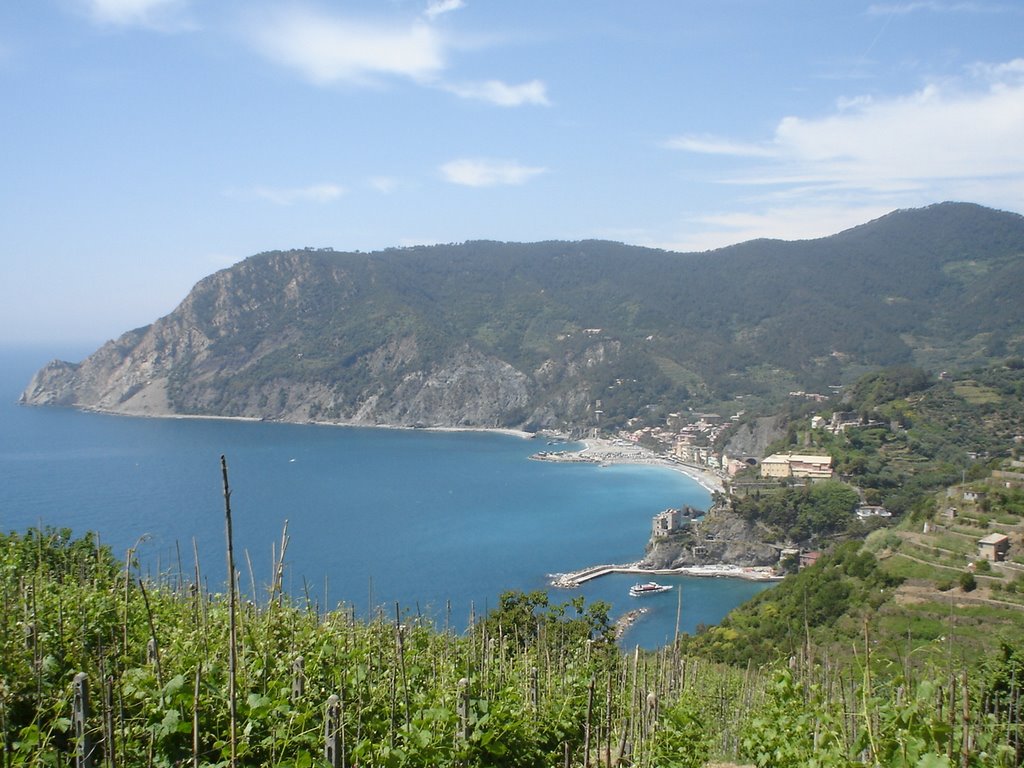
Monterossa - by the sea in Italy.
Monterossa, furthest north seaside village of the Cinque Terre, is a large resort town with a sprawling beach and a once legendary reputation for drawing movie stars.
For us, Monterossa was a beauty that was best enjoyed in the journey.
After visiting all four of the other seaside villages, what wonders would Monterossa reward us with that Sunday morning? From afar, it was idyllic. Glamorous. Beautiful and grand. Yet, uniquely Cinque Terre. And the two hour hike there was unforgettable!
Our hike wandered through sun-soaked vineyards, providing breath-taking vistas and treacherous climbs.
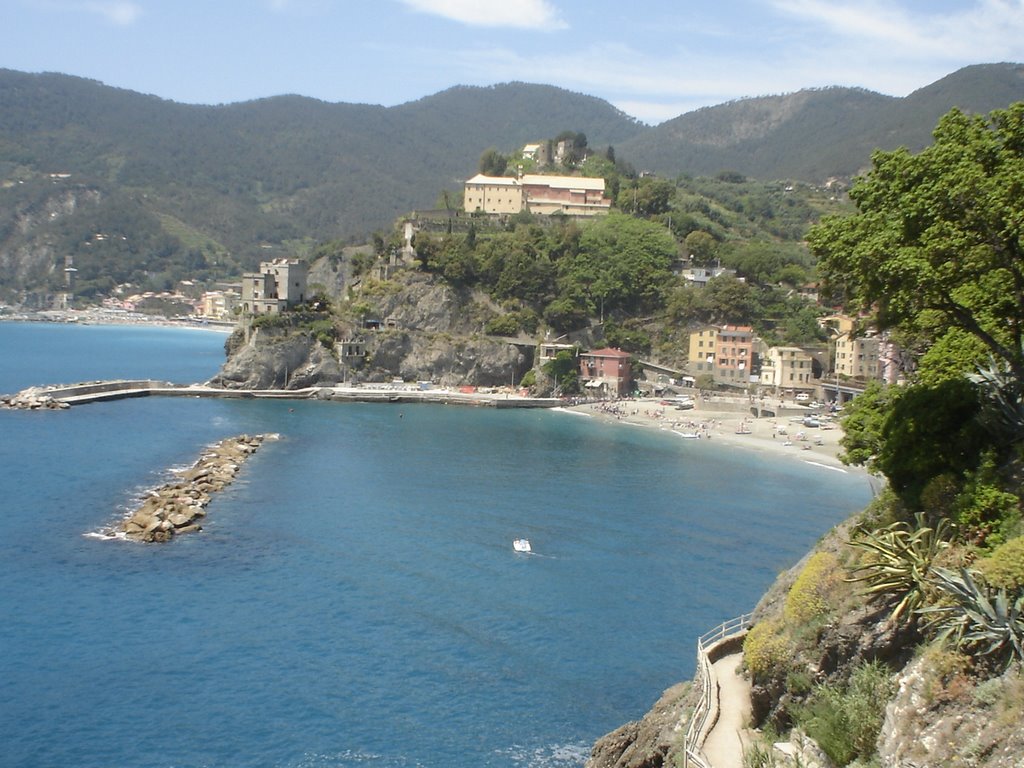
Along the pathway, we edged the Mediterranean from dangling precipices and plunged deep into the hillside olive groves.
The hike had everything you would want. Climbs, plunges, views, sun, shade, variety, challenges, rewards. It was a journey that delighted one minute and threatened in the next.
At times, the pathway narrowed to a mere 10 inches. Dangerous enough when all the hikers were going in one direction. Fairly impossible when hikers approached from the other direction. Maneuvering some of those crevices became a focal point. A matter of safely surviving the trail.
One high point was crossing paths with two college-age girls, walking arm-in-arm and singing joyfully (in English!)with their praise music: "Your love, O Lord, reaches to the mountains. Your faithfulness stretches to the sky."
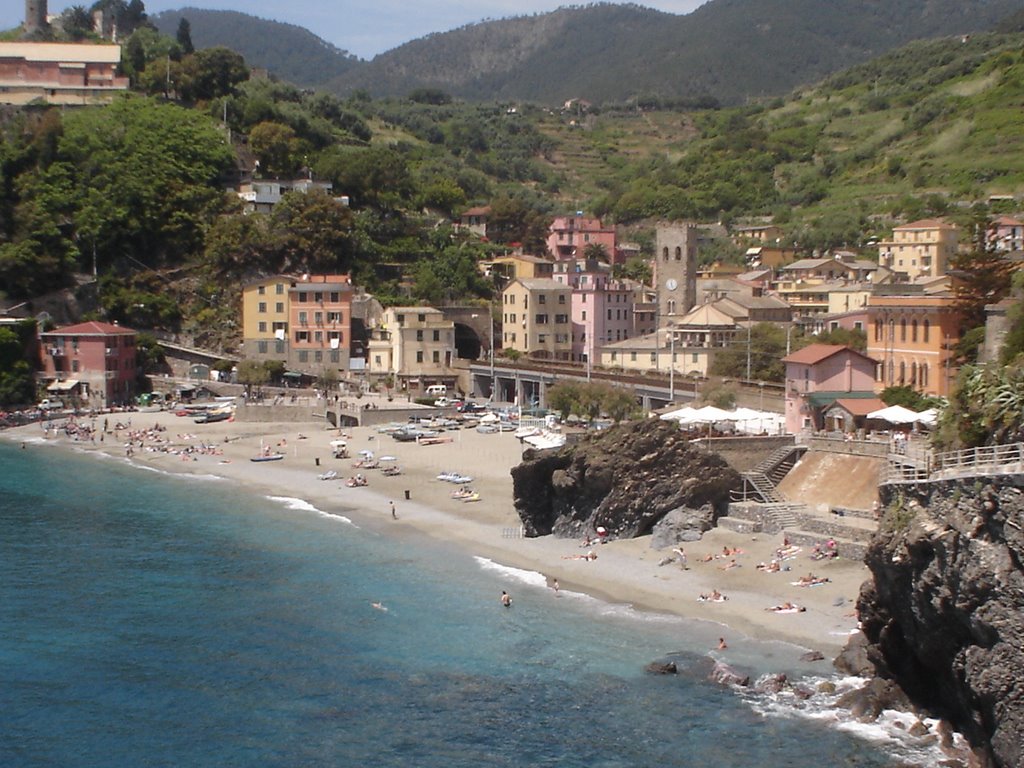
Finally, we arrived in Monterossa. We searched for our expected reward, an Italian gelato! But none were to be found.
We settled for a refreshing lemon granita and wandered Monterossa in hopes of discovering its special charm.
Unfortunately, the beaches, though beautiful, were over-crowded and uninviting. The layout of the city was more modern and less charming than the other villages. It felt less friendly, too.
After a very brief visit, we took the train back to Vernazza and reflected on the best part of our day--the hike to Monterossa.
In reflection, it was a good reminder that beauty perceived only from afar can be deceptive. True beauty is found when one gets past the distant image and examines the heart or essence of the person or place.
And sometimes, the journey can be more beautiful than the destination.
Subscribe to:
Posts (Atom)